
Learn to Transpose, Step by Step
Transposing... what does that mean?
Just imagine: You play the clarinet and you would like to play some
music with the girl next door who is playing the flute. You take her book,
and with the two of you together you start to play the first melody on
page one. How long do you think your performance will last?
I guess: not longer than a second or three...
It sounds HORRIBLE ! ! !
Why?
If a flute player sees the note C and plays it, you will indeed hear the
note C, for flute is a non-transposing instrument.
But if a B-flat clarinet player sees the note C and plays it, you actually
don't hear a real C, but a B-flat.
The pitch of the note sounds a whole note lower than notated.
As long as the clarinet player plays alone, or together with other B-flat
instruments, it doesn't matter, but when a clarinet player wants to
play along with a non transposing instrument, like a flute, a piano,
a keyboard, a violin, or other C-instruments, than he should copy down
his music on a separate sheet of paper and transpose it into another key,
for only then it will fit together, only then will it sound well together with
the other instruments.
Transposing is to summarize in three steps:
1 - write the right key signature.
2 - copy down the notes in the right pitch.
3 - fill in the accidentals.
How to do this exactly we will learn below.
T I P !
If you scroll down and glimpse at the pictures and the text,
it will seem to be a very long and complicated story.
So: Don't do that!
Take the time to read each block of this page and copy down
the example of the notes.
If you do, you will find out it really is not difficult.
How to find out whether your instrument is a transposing instrument or not.
Play a C on your instrument and compare the sound of it with a C played on a piano. (or an organ or keyboard) If the C you played on your instrument sounds in the same pitch as the C on the piano, you don't have a transposing instrument.
If you discover that the note which was notated as a C for your instrument happens to be a B-flat on the piano, then you know your instrument is a B-flat instrument.
Is the C you played on your instrument an A on the piano?
Then you have an A-instrument. Etc.
You still can't find out? Ask your music teacher, or another person who plays the same instrument you do.
You now know to which key you have to transpose? Then you may go on with the next block of this page:
Click here and scroll down
B-flat instrument (Si bemol)
(like a B-flat Clarinet, a Trumpet or a Tenor saxophone)
E-flat instrument (Mi bemol)
(like an Alto Saxophone or a Bariton Saxophone)
F instrument (Fa)
(like an F Horn or an Alto Oboe)
A instrument (La)
(like an A Clarinet)
How to transpose for A-Instruments
Step 1 - Write the right Key Signature
Just imagine we are going to play the next melody together with a violin,
then we will need to change the pitch of our part, in order to play the
same notes the violin does. We need to transpose the violin melody to
make it possible to play it on our A-Clarinet.
So, take a sheet of music paper, a pencil and an eraser, then we can start.
(Click here to print blank staff paper.)
The melody we're going to transpose:

You will notice the flat between the clef and the time signature.
You can't just copy out the flat, for we're going to write in another key, so
we also need different flats or sharps than we had in our original music.
The first question we'll have to ask ourself is:
Which key signature do we need?
In the example above we see one flat, this will become four flats for an
A-instrument. So write on your sheet of staff paper a G-clef, the four flats
(b-flat, e-flat, a-flat and d-flat) and the time signature.
This brings us to the next result:

But how can we know which flats or sharps we need to write in between
the clef and the time signature?
Therefore you look at the table below.
Search on the left column for the sharps or flats as you find them
in the original music, then you will find the key signature you need
on the right for your A instrument.
Table of Key Signatures
for A-Instruments
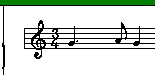

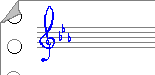
No sharps or flats in the original music?
Schrijf drie mollen: een bes, een es en een as.
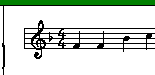
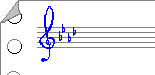
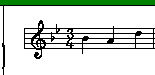
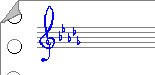
One flat in the original music?
Write down four flats:
B-flat, E-flat, A-flat and D-flat.
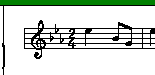
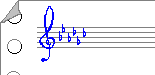
Two flats in the original music?
Write down five flats:
B-flat, E-flat, A-flat, D-flat and G-flat.
Three flats in the original music?
Write down six flats:
B-flat, E-flat, A-flat, D-flat, G-flat and C-flat
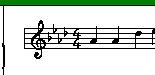
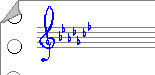
Four flats in the original music?
Write down seven flats:
B-flat, E-flat, A-flat, D-flat, G-flat, C-flat and F-flat.
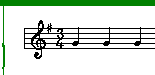
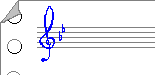
One sharp in the original music?
Write down two flats: B-flat and E-flat.
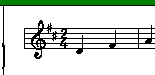
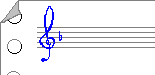
Two sharps in the original music?
Write down one flat: B-flat.
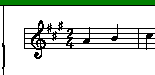
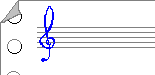
Three sharps in the original music?
In that case your music doesn't need any sharps or flats.
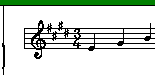
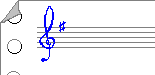
Four sharps in the original music?
Write down one sharp: F-sharp.
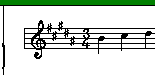
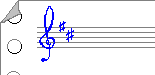
Five sharps in the original music?
Write down two sharps:
F-sharp and C-sharp.
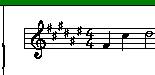
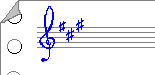
Six sharps in the original music?
Write down three sharps:
F-sharp, C-sharp and G-sharp.
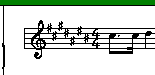
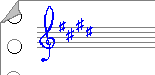
Seven sharps in the original music?
Write down four sharps:
F-sharp C-sharp, G-sharp and D-sharp.
Feel free to use the table above as often you want, but the next rule could be helpful too:
Original music 0 accidentals - A clarinet 3 flats
Original music 1 sharp - A clarinet 2 flats
Original music 2 sharps - A clarinet 1 flat
In all other occasions the A clarinet always gets 3 flats MORE, and 3 sharps LESS than the original music in C.
(You can check this with the table above.)
Step 2 - Copy down the notes in the right pitch
Take a look at your paper, what do we have?
Just the clef, the key signature and the time signature.
So now it's time for the second step: we're going to fill in the notes.
If an A-instrument plays a C, we don't REALLY hear a C, but an A,
as you could read above, for that was why we call it an A-instrument,
remember?
When we think like that we realise that when we play a C and hear an
A, we know our instrument is playing a note (two semi-tones)
lower than the written music.
What would happen if we would write two notes above the C; an E-flat, (Not
an E, for we have a key-signature with four flats remember?) could that
perhaps sound like a C?
Yes!
So that's what we are going to do.
Write out all the notes of our example melody, but in another pitch: exactly
two notes (three semi-tones) above the printed music.
A very important thing to remember is:
Be careful only to copy the notes!
Never and never the accidentals in between the notes ! ! !
Perhaps you think: But this way it doesn't correspond with the original
music!
No, that's right, but we will straighten that out later on this page.
First things first: what you do now is to rewrite the music two notes higher
than the the music on your sheet. The D becomes an F, the E becomes a
G , the F becomes an A-flat (you don't need to write the flat, the key-
signature-flats take care for that), and so we go on, move all notes
two up:

And here you can see how it looks like now.
Step 3 - Fill in the Accidentals
Look at the music above. You will see it immediately: the third measure
isn't ready yet. In the original music we see a natural B and a C sharp, how are
we going to transpose that in our written music?
Just copy it out? Writing a natural and a sharp too?
No way!
Besides, it wouldn't make sense. just take a look: we can't write a sharp
in front of a E-flat can we? (third note, third measure)
When we transpose we should forget the words: 'Sharp', 'Flat' and
'Natural'. Let's take a look, to see what they exactly DO with the notes...
A sharp RAISES the pitch of the note by a semitone, so from now on we
will not talk about 'sharp' anymore, we will call it a 'raise-up-sign'.
A flat LOWERS the pitch of the note by a semitone, so from now on we
will not call this 'flat' anymore, but a 'lower-down-sign'.
A natural in front of an F-sharp, LOWERS DOWN the F-sharp to an F,
so in this case the natural is a 'lower-down-sign', just like the flat.
But a natural in front of a B-flat RAISES UP the B-flat to a B, in this
case the natural is what we call a 'raise-up-sign'.
Let's take a look again at our example:
In the third measure you will notice the natural in front of the B-flat.
What does that natural do?
It tells us the B-flat should go back to its natural pitch, the B.
It RAISES UP the pitch, from B-flat to B, so this is a 'raise-up-sign'.
This means we should add a raise-up-sign in our written music too,
in front of the D-flat.
What is a raise-up-sign in front of a D-flat?
Right! A natural!
In front of the C in our printed music, we see a sharp, this again is
a raise-up-sign, so the E-flat in the written music should get a raise-up-sign
too.
A raise-up-sign for a E-flat is again a natural.
This brings us to the next result:

Now you have finished, the transposed music is ready to play.
You can transpose all your music like this.
What if you dont't want to transpose from C to A,
but the other way around: from A to C?
In the transposing course above you learned to transpose C-music into B-flat-music.
Ofcourse it is possible to transpose it the other way around as wel: from A-music into C-music.
In that case you just do the course the other way around.
In the course above you see two kinds of note examples. The black printed music is the C-music. The blue hand written music is the A-music.
When you want it the other way around, consider the blue hand written music as your starting point and change it into the black printed version.
This means that you have to copy down the music two notes lower, instead of two notes higher, and the table has to be used the other way around too: the blue hand written examples are like the music you already have, change this into the black printed notes.
So: 1 sharp then becomes 4 sharps. 2 flats become 1 sharp. Etc.
Good luck transposing your music!
Margriet Verbeek
|

Margriet Verbeek

Popular arrangements
for 2 recorders (or flutes) and guitar
Free Folk Songs, Christmas Carols and Light Classical Music.
Sound Collage - 2013
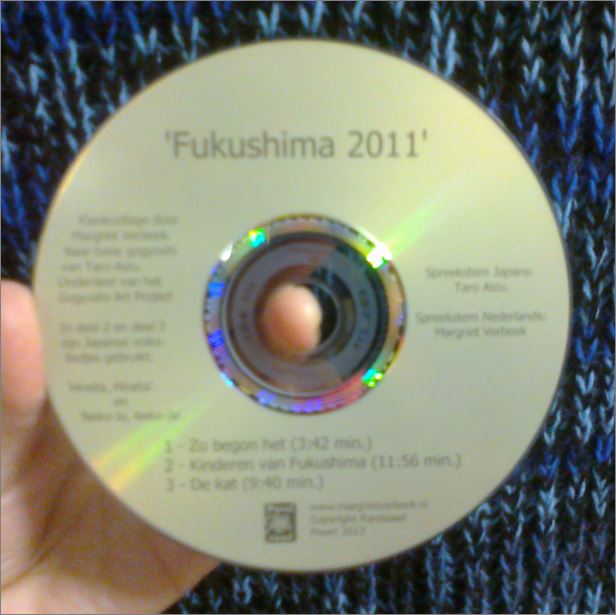 This 25 minutes sound collage is part of the Gogyoshi Art Project International,
inspired by Taro Aizu's poems which he
wrote about the nuclear disaster in his hometown Fukushima in 2011.
This 25 minutes sound collage is part of the Gogyoshi Art Project International,
inspired by Taro Aizu's poems which he
wrote about the nuclear disaster in his hometown Fukushima in 2011.
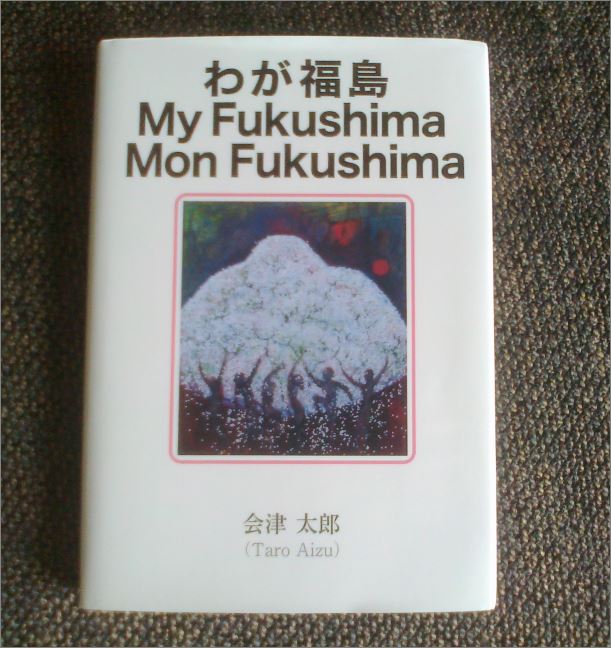
In 2012 was the celebration on the 500th anniversary of the Belgium composer Clemens Non Papa.

50 Dutch and Belgium composers composed for this occasion new versions of his 150 Souterliedekens (psalms) for choir.

November 2011.
Concert in Schiedam to celebrate GeNeCo's centennial (Dutch Composers Association).
May 15, 2010.
CD-presentation in Wilhelminaoord.
Eddy vd Maarel piano,
Margriet Verbeek guitar.

Explaining and performing a Graphic Score with a group of musicians plus the audience, during the European Mensan Annual Gathering in Utrecht, 2009.

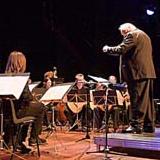 The Dutch Association for Mandolin Orchestras celebrated her 60th anniversary in October 2007, by giving a concert in Gorinchem. Their Youth Orchestra performed The Smoking Chimney under the direction of Benny Ludemann. The Dutch Association for Mandolin Orchestras celebrated her 60th anniversary in October 2007, by giving a concert in Gorinchem. Their Youth Orchestra performed The Smoking Chimney under the direction of Benny Ludemann.
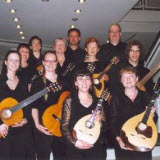
Mandolin-ensemble The Strings, at the first performance from l'Artibonite in Bamberg - 2006"
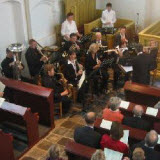 November 2005.
11 members of three brass bands in Midden-Delfland performed Festival in 't Woudt, and Green, Green Midden-Delfland, in the presence of the Dutch Queen Beatrix, directed by Pasha Ashari.
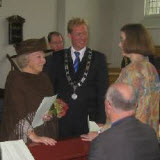
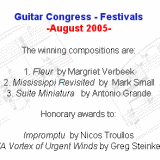
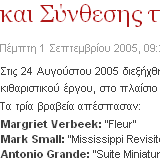
The first price, at the Eight International Competition for Composers in Corfu-Greece (2005), went to the composition
Fleur for solo guitar, by Margriet Verbeek.
|


